

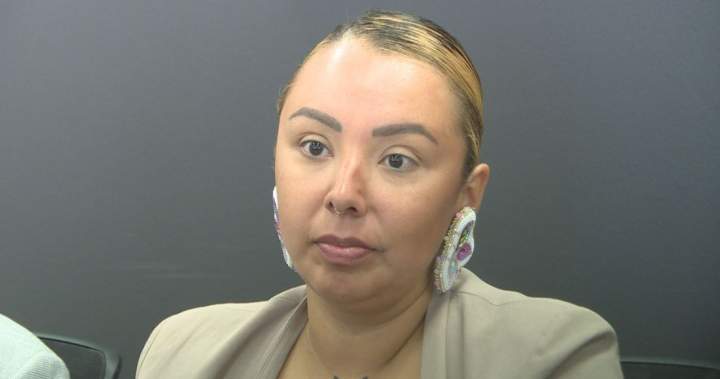
A group of First Nations chiefs in Manitoba is urging the House of Commons to pass a bill removing what they call “discriminatory provisions” of the Indian Act.

At a news conference, the Assembly of Manitoba Chiefs (AMC) called on Ottawa to pass Bill S-2 before the House of Commons adjourns for summer break on Friday.
The bill would update the requirements to obtain status under the Indian Act and remove the second-generation cut-off.
According to Indigenous Services Canada (ISC), that restriction prevents some First Nations people with status from passing it on to their child if two consecutive generations have one parent without status.
In the act, “Indian status” is exclusively provided to people who can verify their ancestral connection to the community. The proposed amendment would permit this status to be passed onto a child, so long as one of their parents is registered under the act.
“No child should lose recognition because of who their parent or grandparent has married or decided to have children with. No families should continue to suffer because of discriminatory provisions created by Canada — not by us,” AMC Grand Chief Kyra Wilson said, addressing reporters on Tuesday.
“Before June 19, Parliament faces a simple choice to pass Bill S-2 and finally remove this discrimination from federal law or leave First Nations families waiting once again,” Wilson said.

Get daily National news
Get daily Canada news delivered to your inbox so you’ll never miss the day’s top stories.
Those who obtain “Indian status” in Canada are entitled to certain rights and benefits, according to ISC. Some status holders are entitled to tax-exempt income, non-repayable financial assistance for post-secondary costs, and treaty rights, which include special fishing, hunting and trapping allowances when on treaty land.
Bill S-2 was introduced in the Senate in May 2025 by Indigenous Services Minister Mandy Gull-Masty. It passed the Senate on Dec. 10 and had its first reading in the House of Commons five days later.
Currently, it is under consideration by the Standing Committee on Indigenous and Northern Affairs, which has hosted five meetings on the bill since April 16. Senators, Indigenous leaders, and many stakeholders have presented to the committee.
“We remain committed to forwarding legislative reform options that address the second-generation cut-off and section 10 voting thresholds in a manner that reflects the perspectives and priorities of First Nations,” reads a statement to Global News from the Office of Minister Gull-Masty.
“It is a critical and deeply personal issue for many individuals, families and communities, and addressing it meaningfully is an important part of advancing reconciliation.”
Seventeen “representative Indigenous organizations” were participating in an expedited collaborative process, according to the statement.
“The collaborative process is designed to consult on how, not whether, to address the second-generation cut-off. Through the collaborative process First Nations communities and organizations have already proposed diverse solutions related to the second-generation cut-off … That includes options beyond the single-parent rule amendment introduced by the Senate,” the statement reads.
“To conclude the collaborative process, First Nations partners will be consulted on those proposals this summer.”
Wilson said she believes the delay in the bill’s movement through the House of Commons is a mechanism to put off the third reading and vote.
The federal NDP Indigenous Affairs critic Leah Gazan has also urged for the bill to be passed expeditiously.
During question period on Monday, Gazan questioned why this bill is having such extensive consultation, while others, such as Bill C-5, moved more quickly.
Since the Indian Act was passed in 1867, dozens of amendments have gone into effect.

© 2026 Global News, a division of Corus Entertainment Inc.
Politics,Assembly of Manitoba ChiefsAssembly of Manitoba Chiefs, Politics#Manitoba #chiefs #urge #Ottawa #pass #bill #expanding #Indian #Act #status #eligibility1781648401